
How Long Does a Home Addition Take, From Permits to Move-In?
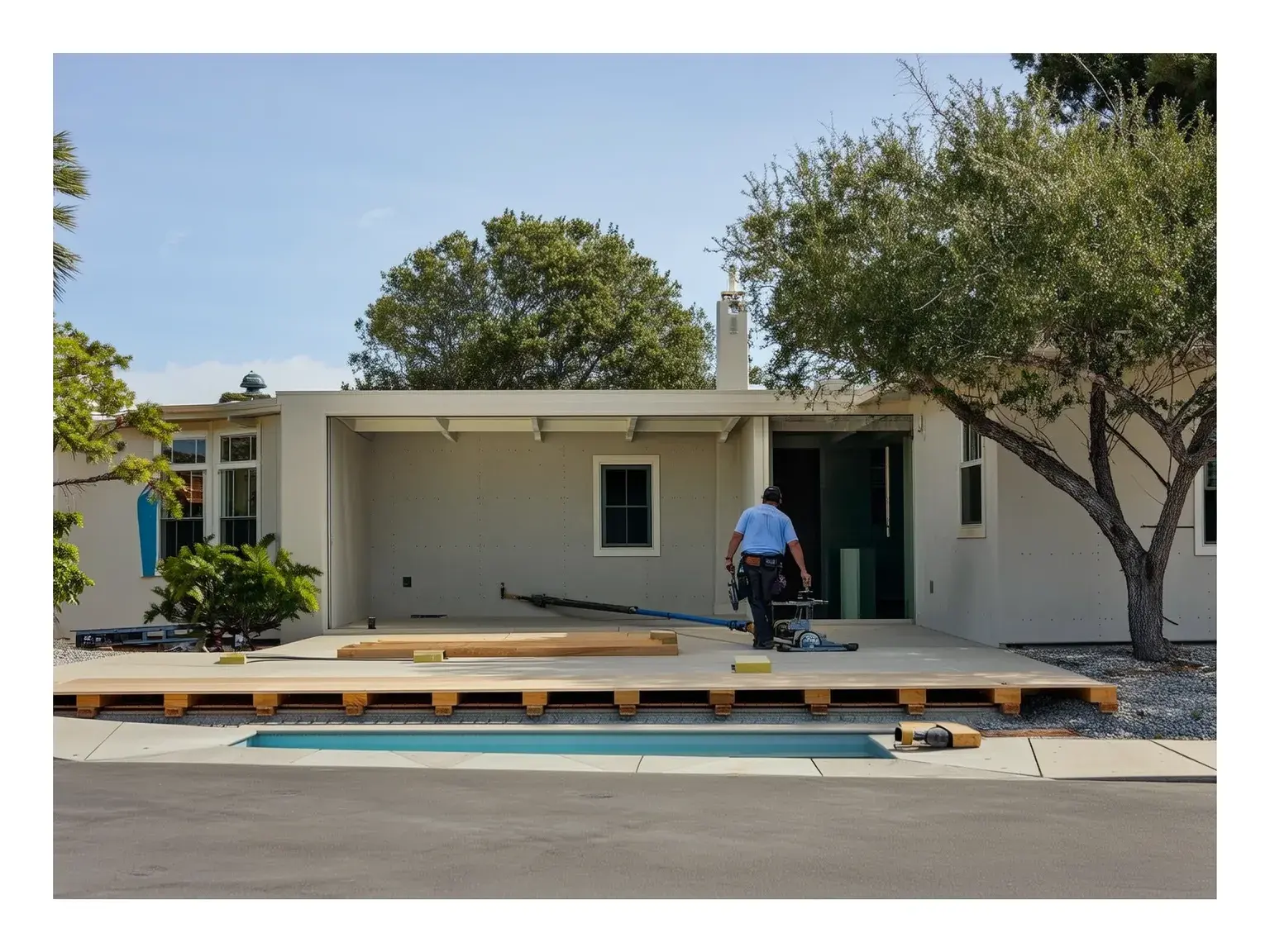
Most Peninsula home additions take about 4 to 11 months from the first design meeting to move-in. Budget 1 to 2 months for design and plan check. Add 1 to 3 months for permit review and approval, longer in cities like Burlingame that require Design Review. Then budget 2 to 6 months to build, depending on the addition's size and scope.
How long does a home addition take from start to finish?
Published national remodeling-industry guides put the full process at about 3 to 12 months. That covers design all the way through move-in. Design and scope take 4 to 8 weeks. Permit review adds another 3 to 6 weeks for a straightforward job. Construction itself runs 1 to 3 months for a small bump-out. A single-room addition runs 3 to 6 months. A second story or a large multi-room project can run 6 to 12 months.
Angel Suarez Construction follows the same basic steps on every job. We start with a free on-site visit and a written estimate. Then we draw your plans and handle the city approvals. After that, the same crew builds your project from the foundation to the last coat of paint. You are never handed off to a different team partway through.
How long does the design and plan-check phase take before you apply for a permit?
Plan on 1 to 2 months for design and plan check. This comes before you can submit a complete permit application. It covers finalizing the scope and drawing the plans to the detail a plan checker needs. It also means working out structural details like the foundation and framing.
Once you submit, state law sets a hard deadline. Under Government Code Section 65943, the city must tell you, in writing, within 30 days, if your papers are complete. If the city misses that date, your papers count as complete on their own. That rule stops your papers from sitting for months with no one looking at them.
How long does permit review take once you apply?
A straightforward job can clear review in about 3 to 6 weeks, the national benchmark. But the 30-day completeness check, the city's own review queue, and any Design Review step can stretch full review and approval to 1 to 3 months on a Peninsula project. The exact time depends on the city and the project's scope. Every city we serve runs its own building department. San Francisco permits go through its Department of Building Inspection. San Mateo and South San Francisco each issue permits through their own Building Department or Division. A contractor who already knows each city's counter and submittal checklist moves faster. That knowledge avoids the back-and-forth that slows review down.
Call Angel Suarez Construction for a free estimate. We will walk you through the exact permit steps your city requires before you pick a start date.
Why do second-story additions in cities like Burlingame take longer to permit?
A second story usually adds a full extra review step. Burlingame requires a Design Review application to the Planning Commission for all new houses. Most second-story additions need one too. The Planning Commission checks the project against the city's Residential Design Guidebook. That guide looks at how the new design fits the existing home and the neighborhood around it. This step comes on top of the standard building-permit plan check every addition needs.
A second story also adds real structural work. It needs a strong foundation and structural base to carry the new floor. We may also add seismic bracing to keep the home safe in an earthquake. We match the new roofline and roof to your existing house too. All of that extra design and engineering work adds time before construction can even start.
How long does construction take once the permit is issued?
Once your permit is issued, a home addition typically takes 2 to 4 months to build. A full ADU takes 3 to 6 months. The exact time depends on the size and how much foundation work it needs. An attached ADU shares one or more walls and some utilities with your house. That often makes it build faster. A detached ADU stands fully on its own. It has its own foundation, kitchen, bath, and entrance, so it usually takes longer.
As of 2026, a Bay Area room addition runs roughly $200 to $500 per square foot. A full ADU runs about $150,000 to $400,000. Those are published market ranges, not our quote. See the real cost range for a Bay Area addition or ADU for the full breakdown.
Does building an ADU instead of an addition change your permit timeline?
Yes, in one specific way. State law gives an ADU its own 60-day clock, under Government Code Section 66317. The city must say yes or no within 60 days. It cannot hold a hearing on it. Miss that date, and the city's answer counts as yes. A general room addition or second story does not get that same date. It goes through the city's normal plan check instead, plus Design Review where the city asks for it.
See whether your project needs a separate ADU permit for the full state-law process. It shows how the rules play out city by city on the Peninsula.
What slows a home addition timeline down the most?
Two things cause most real-world delays. The first is how fast you make decisions on finishes and layout. The second is how long your chosen materials take to arrive. In our experience, these two factors matter most. They move a schedule more than almost anything else on the construction side.
There is also a deadline that kicks in after your permit is issued. San Bruno requires construction to finish within a set window tied to the job's value. The smallest jobs, worth up to $50,000, must finish within 6 months. The largest projects get up to 36 months. Run past it, and daily fines kick in. A realistic schedule set up front helps you avoid that. So does a contractor who tracks that clock for you. Together, they keep a project from running into a penalty it never needed to face.
We are a licensed California B General Building contractor, CSLB License #1085926. We have built additions and ADUs across the Peninsula since 2021. See our full remodeling and construction team for everything else we build. Visit our home additions and ADUs page for how we handle design and permitting on every project. Burlingame homeowners and neighbors in Millbrae work with the same local process.
Ready to get a real schedule for your project? Contact Angel Suarez Construction for a free visit and written estimate. We serve San Bruno and the nearby Peninsula, including South San Francisco, San Mateo, Burlingame, Millbrae, and San Francisco.
Talk to Angel Suarez Construction
Questions about your general contractor job? We serve San Bruno and the surrounding area with honest, upfront advice.
Related articles
FAQ
Related questions
What happens if a home addition isn't finished before the permit expires?
San Bruno sets a time limit tied to the job's value. A project valued up to $50,000 must finish within 6 months of the permit date. Bigger jobs get more time, up to 36 months for the largest projects. Miss the deadline and daily fines start at $200 a day, then climb to $1,000 a day. You can ask the city for an extension before your permit expires, which avoids the fines.
Can a home addition permit move faster in some Peninsula cities than others?
Timelines vary because each city we serve runs its own building department and reviews its own plans. San Francisco permits go through its Department of Building Inspection. San Mateo and South San Francisco each use their own Building Department or Division. For an ADU specifically, Millbrae offers a pre-approved plan checklist that can skip part of the custom design review a one-of-a-kind addition needs elsewhere.
Is a bump-out addition faster to build than a full room addition?
Yes. Published national timeline guides put a small bump-out at 1 to 3 months of construction. A single-room addition runs 3 to 6 months. A second-story or large multi-room addition can run 6 to 12 months. Size and structural scope, not just square footage, drive most of that difference.
Does a small addition still need Design Review in Burlingame?
Not always. Burlingame exempts an addition or uncovered deck of 200 square feet or less from Design Review, as long as the roof pitch matches your existing roof and the ridge height follows the city's rules. A bigger addition, or almost any second story, still goes to the Planning Commission.